Whales of the Bay of Fundy
Every summer the mouth of the Bay of Fundy fills with feeding whales, from small minkes to fin whales second only to blue whales in size, and a few of the world's rarest.
Bay-wide · from Saint John: One to two hours
Tide note Every boat, including kayaks and paddleboards, must keep a legal minimum distance from whales, with stricter rules for right whales. Look up the rules in force for the season you visit.
The Bay of Fundy is famous for its tides, and the tides are the reason it is also one of the best places in eastern North America to see whales. Twice a day, enormous volumes of water pour in and out of the bay. Where that flow meets the deep basins and ledges at its mouth, cold, nutrient-rich water is pushed up toward the surface. Plankton thrives, krill and small fish gather in huge numbers, and from early summer into the autumn the whales come to feed.
Why the whales come
The richest feeding grounds lie in the outer bay, around Grand Manan, the Wolves, Campobello and the passages of Passamaquoddy Bay, and across toward the Nova Scotia shore. Strong tidal currents around islands and headlands concentrate food along tide lines and in upwellings. Herring, the fish that built the weir fishery of the islands, are a staple for many whales, as are krill and the tiny copepods on which right whales depend.
Whales start arriving in late spring and early summer, and their numbers grow through July and August. September is often one of the best months, with many animals still feeding and calmer, clearer weather. By October most have begun to move away. Each year is different, and the whales go where the food is.
The whales you are likely to see
Fin whale
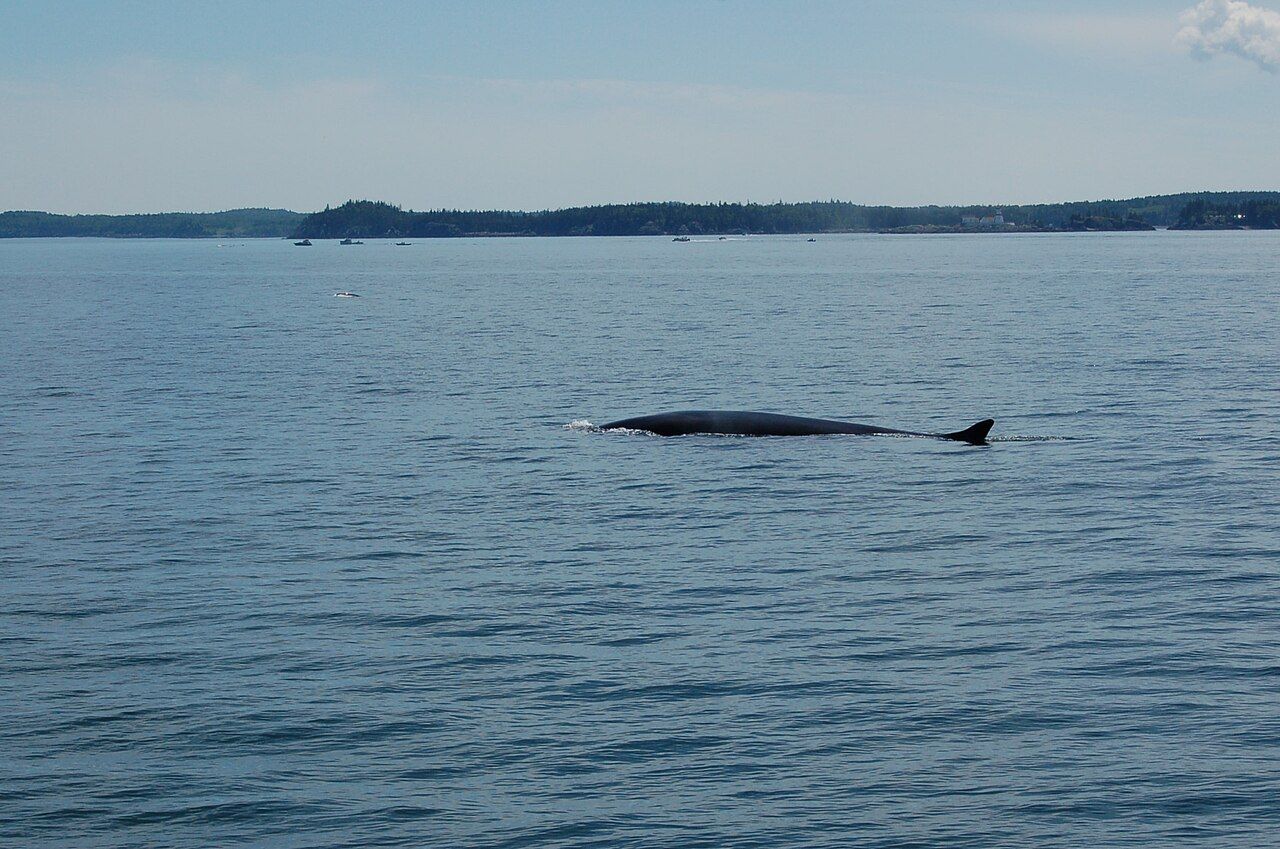
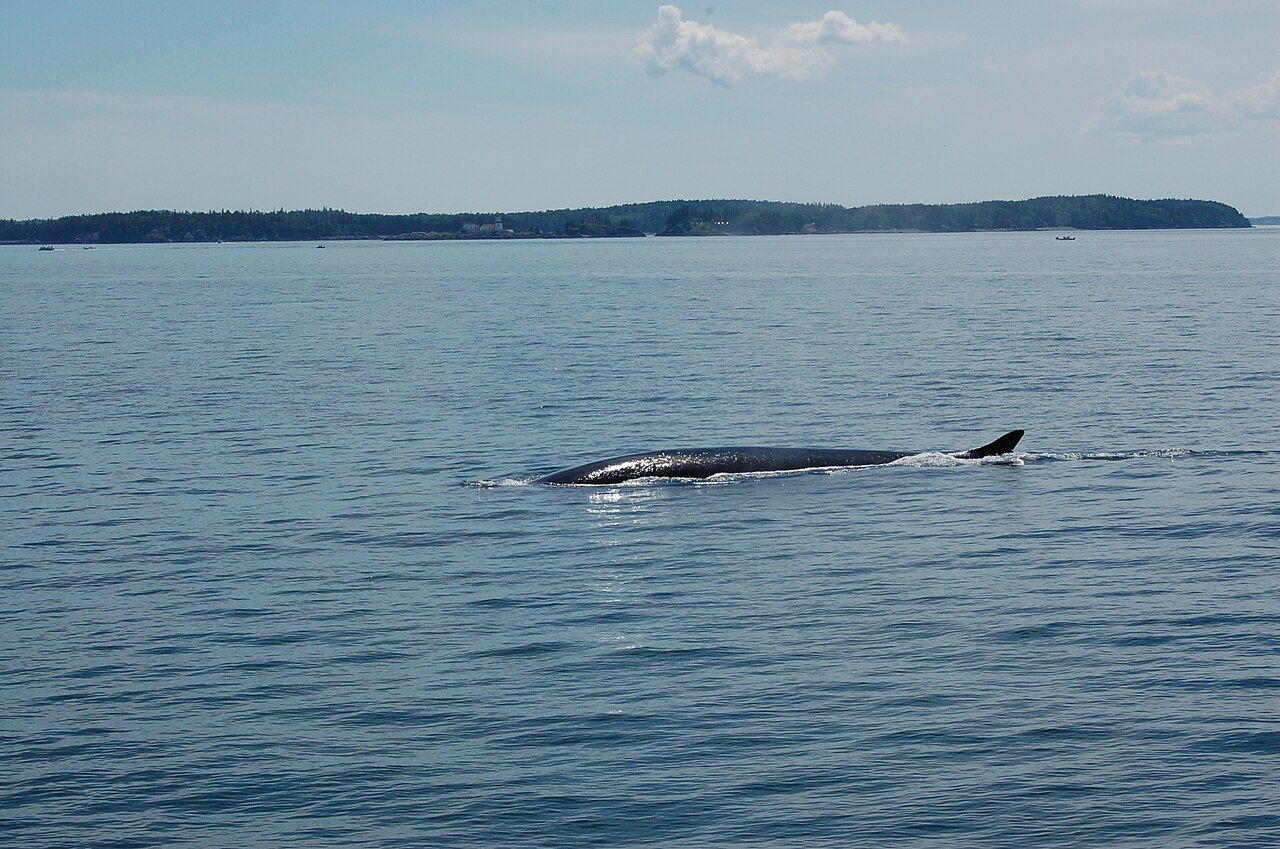
The fin whale, or finback, is the second-largest animal on earth after the blue whale, reaching around twenty metres or more. It is long, sleek and fast, with a tall, narrow blow and a small, swept-back dorsal fin that appears well after the blow. A distinctive feature is the colouring of the lower jaw, white on the right side and dark on the left. Fin whales are among the most common large whales in the outer bay.
Minke whale
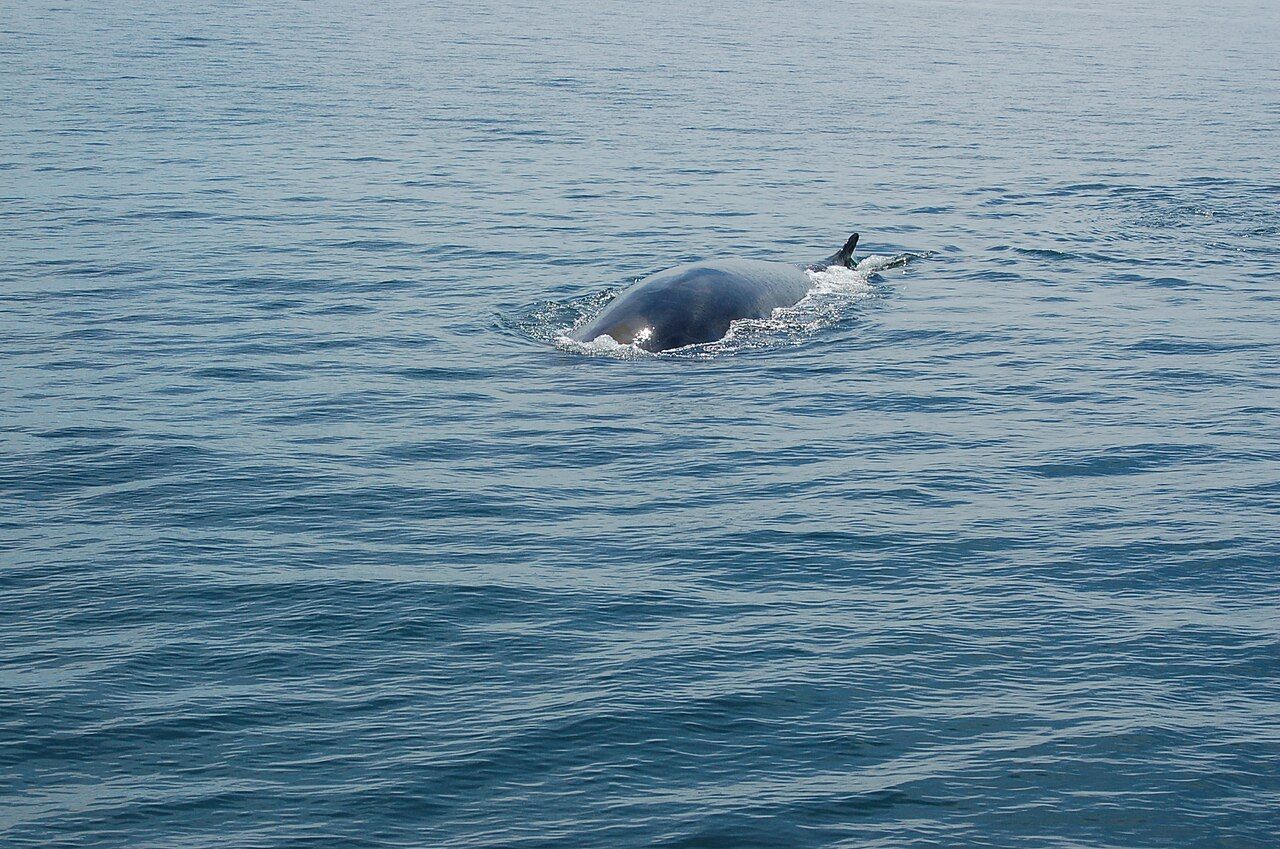
Minke whales are the smallest of the baleen whales here, often under ten metres. They surface quickly, show a small curved fin and rarely raise a visible blow. They are often seen close to islands and headlands, including from shore, and sometimes from the ferry.
Humpback whale
Humpbacks are the whales most people hope for. They are stocky, with very long white flippers and knobbly heads, and they often lift their tail flukes high before a deep dive. The pattern of black and white under each tail is unique, and researchers identify individual whales from photographs of them. Humpbacks sometimes breach, lob their tails or slap their flippers, but they spend most of their time quietly feeding.
Porpoises, dolphins and seals
Harbour porpoises are common in the bay, small and shy, showing only a dark back and a little triangular fin as they roll. Atlantic white-sided dolphins appear in groups farther out. Harbour seals and grey seals rest on ledges around the islands and are often seen from shore, as at Swallowtail and the North Head shore.
The North Atlantic right whale
The North Atlantic right whale is one of the most endangered large whales in the world, with only a few hundred animals left. It is a dark, broad, slow whale with no dorsal fin, a V-shaped blow and rough pale patches on its head. It was named by whalers as the right whale to hunt, because it swims slowly, feeds near the surface and floats when killed. Centuries of whaling brought it close to extinction.
For decades, the deep basin east of Grand Manan was one of the most important late-summer feeding areas for right whales, and mothers brought their calves there. In recent years many of the whales have shifted much of their feeding elsewhere, following changes in their food, and sightings in the bay have become less regular. They still pass through and still feed here at times.
The greatest threats to right whales today are collisions with ships and entanglement in fishing gear. Both Canada and the United States have put special measures in place, including shipping lane changes, speed restrictions and fishing closures in areas where right whales are present. If you see one, count yourself lucky and give it every bit of room the rules require, and more.
If you see one, count yourself lucky and give it every bit of room the rules require, and more.
Distance and behaviour on the water
In Canadian waters, the law sets a minimum approach distance for all whales, dolphins and porpoises, and the distance for endangered right whales is greater. In nearby United States waters, the required distance for right whales is larger again. The rules apply to every vessel, whether a large tour boat, a fishing boat, a sailboat or a kayak, and they also cover drones.
A few general principles hold in every case:
- Never chase, surround or cut across the path of a whale.
- Slow down when whales are nearby and keep a steady course.
- If a whale approaches your boat, stop or move away slowly and let it pass.
- Do not feed, touch or swim with whales, dolphins or seals.
- Limit the time you spend with any one animal.
Kayaks are not exempt. A whale may not notice a small, quiet boat until it is very close, which is dangerous for both. Paddlers should keep well away from feeding areas and stay alert in fog, when even a large animal can surface without warning.
Where and how to watch
Licensed whale-watching boats run in summer and early autumn from Grand Manan, Campobello, Deer Island and St Andrews, among other places. Trips usually last a few hours, head into open water and depend on weather and sea. Fog may cancel them or turn them into slow listening sessions, with the sound of a blow coming through the grey before the whale is seen. Dress warmly: it is always colder on the water than on shore.
You can also watch from land. Headlands at the north end of Grand Manan, East Quoddy Head on Campobello and Deer Island Point overlook busy tide rips where whales and porpoises feed. A good pair of binoculars, a calm day and some patience are all you need. The Campobello shore is described in Campobello Island and the Roosevelt cottage, and the water off Deer Island in Deer Island and the Old Sow whirlpool.
Reading the water
Look first for blows, the plume of breath that rises above the surface when a whale exhales. On a calm day they can be seen from a long way off, and the shape helps tell species apart: tall and narrow for a fin whale, bushy for a humpback, V-shaped for a right whale. Next look for seabirds gathering and diving, which often means fish near the surface and feeding whales below. Then watch the tide lines, where smooth and rippled water meet. Whales, porpoises and birds all feed along them.
Patience matters more than luck. Whales dive for several minutes at a time, and a long wait often ends with a blow in an unexpected direction. Sit, watch and let the bay show you what is there.