Deer Island and the Old Sow whirlpool
A short free ferry ride from the mainland, Deer Island is a quiet place of coves, wharves and salmon pens, with one of the largest tidal whirlpools in the world off its southern tip.
Deer Island · from Saint John: About an hour, then the ferry
Tide note The Old Sow forms on a rising tide, roughly a few hours before high water. Watch from shore; the currents off the point are dangerous for small boats.
Deer Island lies in Passamaquoddy Bay, between the New Brunswick mainland and Campobello, about twenty minutes by ferry from shore. It is small enough to drive end to end in under half an hour, and quiet enough that a long afternoon can pass with little more than a walk along a wharf and a look at the water. People come for that quiet, for the views over the islands and the bay, and for the Old Sow, a whirlpool that spins off the island's southern point when the tide is running.
The ferries
A free provincial ferry crosses to Deer Island from Letete, on the mainland south of St George, not far from the Grand Manan terminal at Blacks Harbour. The crossing is short, threading between small islands and salmon farms, and boats run frequently through the day, all year round. There can be lines in summer, especially on weekends, and the order of boarding follows the line. Check the schedule before you go.
At the other end of the island, small seasonal ferries have run to Campobello and, at times, across to Eastport, Maine. They depend on the season and the weather and have changed over the years. Taken together, the free ferry, Deer Island and the summer crossing to Campobello make a pleasant loop through the Fundy Isles. The full picture is in ferries and roads around the bay.
The island and its villages
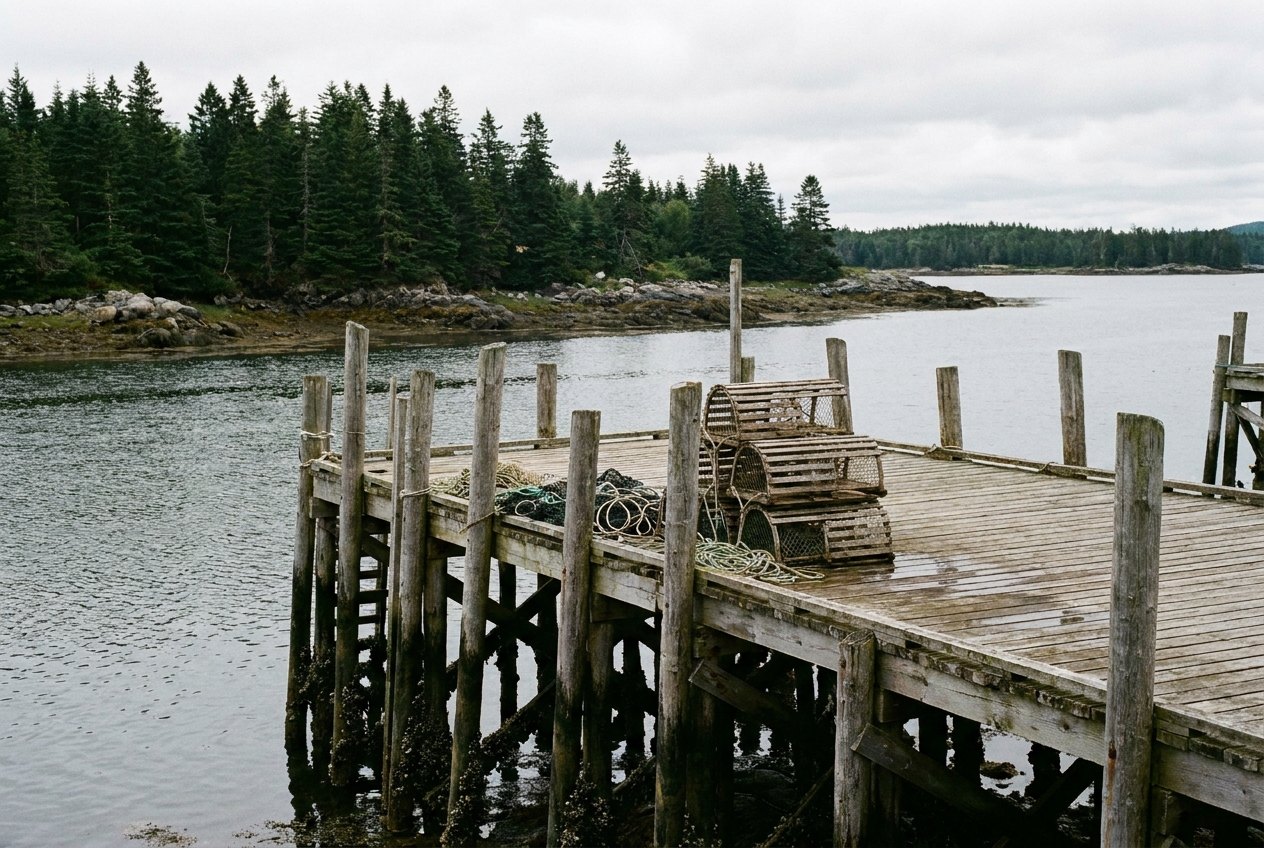
One main road runs the length of the island from the ferry landing at the north end down to Deer Island Point in the south, with side roads to coves and harbours. The villages are small fishing communities: Lords Cove, Richardson, Leonardville, Fairhaven, Cummings Cove and others, each with a wharf and a cluster of houses facing the water. Lobster boats, herring carriers and the service boats of the salmon farms come and go through the day.
Fishing has always shaped the island. Herring weirs stood in many of its coves, and some still do. Lobster pounds, enclosed areas of shoreline where lobsters are held in the sea after they are caught, line parts of the coast. Atlantic salmon farming arrived in the late twentieth century, and the round pens anchored in sheltered water are now part of the view almost everywhere in Passamaquoddy Bay. Look at the gear and the wharves from public ground, and keep clear of boats being loaded or unloaded.
The Old Sow
The Old Sow is one of the largest tidal whirlpools in the world and the largest in the western hemisphere. It forms in the channel between Deer Island Point and Moose Island, where Eastport stands on the Maine side. As the tide floods into Passamaquoddy Bay, the water is forced through the narrow passages between islands, over a deep and uneven bottom, and the currents twist into a field of boils, eddies and smaller whirlpools, with one large spinning centre on a strong tide.
The name is often said to come from the snuffling, grunting sound the water makes as it turns, though some say it was once called the sow-hole or the sough, an old word for a rushing sound. Either way, it is a sight that can hold you for an hour.
The whirlpool is not always present, and it is not always the same size. It is strongest on a rising tide, usually a few hours before high water, and largest around the new and full moons, when the tidal range is greatest. On a neap tide, or at slack water, you may see only swirls and lines on the surface. Check a tide table, arrive at Deer Island Point well before high tide, and give yourself time to watch the current build. The reasons the tides here are so strong are explained in understanding the highest tides.
Watching from Deer Island Point
Deer Island Point, at the southern tip of the island, has a park with open ground overlooking the channel. From the grass and the rocks you look across to Campobello and Eastport, and down on the water where the Old Sow forms. Binoculars help: the whirlpool can be some distance offshore, and the patterns in the current are easier to read at magnification. Bring a picnic and a warm layer, as the wind off the water is often cool.
Stay above the high-tide line on the rocks and watch your footing. The water in the channel is very cold and moves fast; it is no place to swim or wade. Small boats and kayaks should keep well clear of the whirlpool and the surrounding eddies, which can spin a small craft around or pull it under in strong conditions. Look for whales and porpoises too: they often feed in the tide rips off the point, as described in whales of the Bay of Fundy.
Walking and slow days
There are short walks around the island, along shore roads and paths to small points and coves. Chocolate Cove, near the northern end, and the shores around Leonardville are pleasant at low tide, when rock pools and seaweed-covered ledges appear. Keep an eye on the time and on the water as it returns, and do not walk out to islands or bars that may be cut off as the tide rises. The tide range here is several metres, and the water returns within a few hours.
Deer Island is a working place rather than a resort. Services are limited, especially outside summer, so carry what you need for the day, including food and water.
Half a day at the point
- Allow at least half a day, more if you want to watch a full tide at the point.
- Check the tide table so you reach Deer Island Point a few hours before high water.
- Expect lines at the mainland ferry on summer weekends.
- Stay well back from the water's edge at the point.
Deer Island makes a good link between the mainland and Campobello Island and the Roosevelt cottage, or a quiet day on its own. Arrive early, watch the bay fill and turn, and let the tide set the pace.